How And Why I Booked A Round-The-World Trip In Premium Cabins

Yes, you’re still reading Seat 31B. If you’re a regular reader of this blog, you know I mostly write about travel to unconventional places via unconventional routes, and about squeezing the maximum value out of your points (in terms of money you would have actually spent). You’re a lot more likely to read a review of an economy class flight to Ecuador on the worst seat in a regional jet here than you are to read about Cathay Pacific First Class.

And yet, the latter is exactly what I booked as part of the round-the-world trip I just completed. I’ll be writing a lot about South Africa and St. Helena over the next week or so but the elephant in the room is the long-haul flights. They were all booked in premium cabins and this is fairly uncharacteristic for me so I figured I’d write a post about why I spent my miles this way, and why in this specific case I think it made sense for me, given my personal situation and the opportunities I had. I will also write two “deep dive” articles about the mechanics and economics of booking these flights.
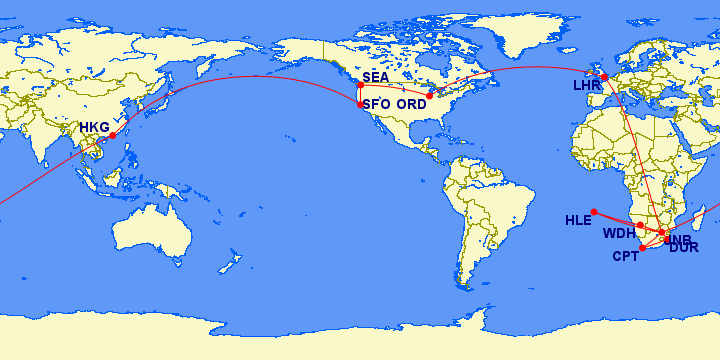
A whooooole lotta flights

The Flights

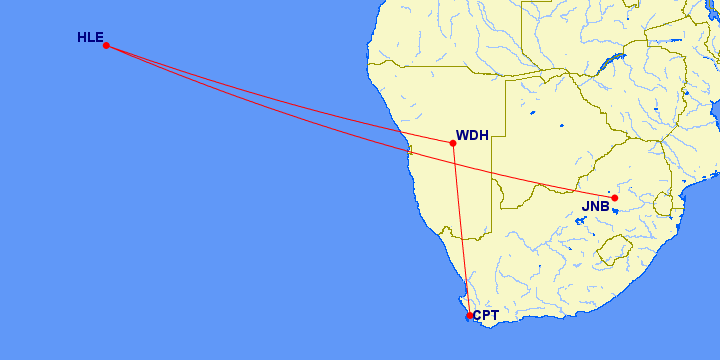
Getting to St. Helena requires starting from Johannesburg (you can also buy tickets to and from Cape Town, but these currently connect through Johannesburg). It’s a really unique flight in a lot of ways, the operations and marketing are very strange, and that’s an entire article in and of itself but these tickets are only sold ex-South Africa. The largest number of international flights into South Africa (by far) land in Johannesburg, although there are also international flights to Durban and Cape Town. I ultimately decided to book the outbound to St. Helena from Johannesburg and return to Cape Town, both because it was cheaper and because I wanted to visit Cape Town.

So, this meant that I had to get to Johannesburg, one of the most difficult destinations in the world to reach using miles and points. And making matters worse, I had decided almost at the last minute that I was going to take the trip. This is because unexpectedly, due to a threatened lawsuit, business in my company ground to a halt. This wasn’t something that was going to be resolved quickly. The tech industry more or less shuts down from the middle of December through the middle of January (people take off for Christmas and then it’s CES, so nobody really gets back to work until the 15th). So, I found out a week before Christmas that I was going to have about 3 weeks free. I booked everything starting just 8 days beforehand.

Of course, this wasn’t easy. At all. I was looking to fly over the holidays (or “festive season” as they call it in South Africa and St. Helena) when flights are absolutely packed. However, you can sometimes score last minute seats, especially when you only need a single seat. This is because airlines will give away unsold seats to frequent fliers at the last minute, and they will also generally return last minute cancelled seats to inventory.

You don’t always have to book award flights 330 days in advance

The conventional wisdom when it comes to booking award travel is that you need to start 330 days in advance when the booking calendar opens. Like most conventional wisdom there is some truth to it, but it isn’t the only truth. The reality in the current state of the industry is that revenue management systems at many airlines regularly evaluate seat inventory and make seats available to frequent fliers based on anticipated revenue load.

This means that, with many airlines, you have multiple opportunities to score an award seat. Consider a flight where five business class seats were made available for awards. The airline might initially make two seats available 330 days in advance. However, they might open up another two seats 20 days before departure (allowing the seat to be booked, but allowing themselves to collect a close-in booking fee). Another seat might open up 3 days before departure if it has remained unsold, with the final seat made available on the day of departure. People also sometimes need to cancel their flights at the last minute. There is an influenza epidemic this winter. Someone else’s flu misery might be your travel opportunity, because most airlines will put award seats that were cancelled up for grabs.

This is what saved me. I was able to book the whole thing using the mileage currencies I wanted thanks to last-minute inventory becoming available. What was available to book? A mix of the world’s most aspirational and least aspirational first and business class products. In the end, it cost me under $300 in cash to literally travel all the way around the world, in premium cabins, on all but one leg of my journey. If I’d paid cash, this would have cost over $30,000. And if I’d bought a discounted business class fare, it would still have cost me about $7,000.

Why I Booked In Premium Cabins

I normally fly in economy class and look for “sweet spots” on award charts to travel the maximum distance and squeeze the maximum value out of the fewest number of points. However, I consider Africa to be a “sour spot” destination in economy class. Depending on the award program you use, it can cost 50,000 points in economy class for a one-way trip to Africa. And South Africa is really far away. From Seattle, it’s 14,237 miles when routing via Asia.

Meanwhile, the price in a premium cabin to Africa is–depending on the program you are using–almost the same cost as a trip to Europe or Asia. It’s about twice as far, making the value of a lie-flat seat considerably more valuable; however, unlike in economy class, this doesn’t actually cost any (or much) more. It takes a solid 27 hours (or more) of flying to get to South Africa, so this is one of the few places in the world where the upgrade is truly worth the extra miles.

Wrap-Up

I was able to book my trip during absolutely peak travel periods, to one of the most difficult to book award travel destinations, and do it all without paying fuel surcharges. And I was able to redeem the points that are, in practice, the most difficult to redeem for this destination and the most at risk of devaluing. The way that I was able to accomplish this was by being flexible and using multiple points currencies. Award travel booking is part art and part science. I think this was a great redemption, and an amazing trip!

Avianca Miles Now Expire After 12 Months

Avianca LifeMiles is, in my opinion, one of the least trustworthy award programs out there. Nominally affiliated with the Colombian airline Avianca, but actually a spun-off independent company like Air Canada did with Aeroplan (which is owned by a company called Aimia, and whose points are likely to become worthless in 2019), they offer regular mileage sales, only to devalue the miles almost immediately. Devaluations have sometimes happened with no advance notice.

Well, LifeMiles is at it again. This time, it’s a stealth devaluation. You need to earn miles at least once every 12 months, or your miles will evaporate. If you somehow manage to get the LifeMiles credit card (which is issued by Banco Popular of Puerto Rico, an astonishingly difficult bank with whom to do business) activity will extend your miles by 24 months. Here is the official announcement:

lifemiles validity shortened

I never advise anyone to maintain large LifeMiles balances anyway. If you use this program, have a plan to burn the miles (which can be more difficult than you may expect due to IT issues, Starnet blocking and more – you’re in for a roller coaster ride). And if you have points, prepare for their validity to be shortened. Burn your LifeMiles now – in my view, you cannot trust this program.

British Airways – Cape Town to Durban In Economy Class

One of the most unique parts of the British Airways operation is in South Africa. BA operates long haul flights from London to Cape Town and Johannesburg. However, they also have a branded domestic operation within South Africa (operating in all major cities) and a regional operation between South Africa and other destinations in southern Africa (Mauritius, Namibia, Zambia, and Zimbabwe). The flights are competitively priced versus South African Airways, although fares are usually a bit higher than low cost carriers (including Kulula, its affiliated carrier). And they operate a nonstop route between Cape Town and Durban, which is a route I wanted to take. Better yet, the flight was competitively priced versus the low cost carriers (I was able to book a sale fare) and even better than that, I was able to book the trip using my Chase Ultimate Rewards points.

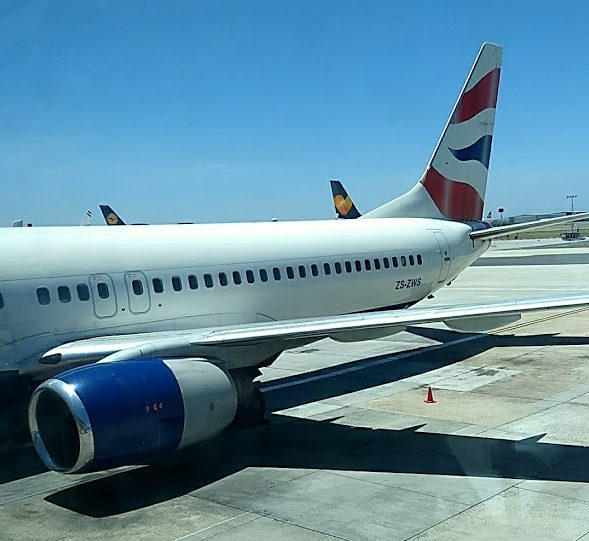
“But wait a minute,” you might be saying. “That’s cabotage!” And yes, it would be, except that BA actually operates via a franchisee in South Africa. The operating carrier is Comair. There is a decal on the front of the plane (which is easy to miss) that indicates this and the flight attendants announce “operated by Comair” when stating the flight number, but most people would have no idea that they’re not flying with British Airways. The branding, marketing, frequent flier program, uniforms, Web site and even the inflight magazine are all BA. In fact, the only thing that would tip you off that it’s not quite BA is the fact that in South Africa, BA remains a full service carrier.

BA operated by comair 737-800

You’d never guess that this British Airways aircraft is actually operated by Comair

While BA sells domestic European fares that don’t include a carry-on bag, and BA has also cut meal service on its intra-Europe flights, Comair has maintained British Airways as a full-service carrier. I’m not entirely sure why this is the case; maybe it’s because they want to differentiate the product from their own low-cost carrier Kulula, or maybe it’s because they want to be competitive with South African Airways (which is also a full-service carrier). It’s also possible that the franchise agreement dictates the services they’re required to offer. Nevertheless, the service is differentiated in a good way.

I boarded late, so didn’t get good pictures of the aircraft cabin. However, there are a few things that were interesting. The first is that the “Club” cabin is different than both US first class carriers and domestic European carriers. The seats have slightly more pitch than economy class. They are slightly wider as well. This means there are 5 seats across in “Club” class (3×2), versus 6 across (3×3) in economy class. On a US domestic carrier, first class would be 2×2 and on British Airways in Europe, “Business” class would be 3×3, but with the middle seat blocked out. I think that this configuration is interesting; it’s more like a premium economy class than a business class, but with a wider and more comfortable seat.

My seat was in economy class. Like the rest of the British Airways operation, you have to pay for seat selection until check-in. I wasn’t able to check in using the mobile app, so ended up checking in online late via the BA Web site. This meant that the only two available seats were the very back row (right up against the toilet) or a middle seat in the front. Since I am on the road I didn’t have (or have access to) a printer. However, that’s OK; British Airways lets you compete the check-in procedure online (so you can select a seat) and then print out a boarding pass at the airport.

When I got to the Cape Town airport to check in, I asked whether any better seats were available. There was an “exit row” available. However, the seat maps with BA are really strange about what is considered an exit row. The very last row of the plane–the one where all the seats back up against the toilets and don’t recline–is considered an “exit row,” because it’s close to the rear exit. However, this comes with none of the benefits. In my case, I was given a seat in the row in *front* of the exit row, which isn’t actually an exit row at all, and which doesn’t recline. However, a non-reclining seat near the front beats a non-reclining seat right next to the toilets, so I was happy to move.

Since I carry the Chase Sapphire Reserve, I have a Priority Pass. I had enough time to visit a lounge and this granted me access to the Bidvest Premier Lounge. Although the lounge is a contract lounge in Cape Town, it’s actually really nice. There was an excellent lunch spread with both hot and cold dishes, a great beverage selection, and the lounge wasn’t crowded. There are even showers available for domestic flights (although they are temporarily not available in Cape Town due to government restrictions on water usage–Cape Town is suffering from the worst drought in 100 years). There is also a large table upstairs with power outlets and good, fast WiFi so you can get some work done. While I’m not sure any lounge is worth going to the airport early, it’s a great place to kill time if you do arrive early. The main part of the Cape Town terminal is great for Africa, but the gate areas can get very crowded because there is limited seating.

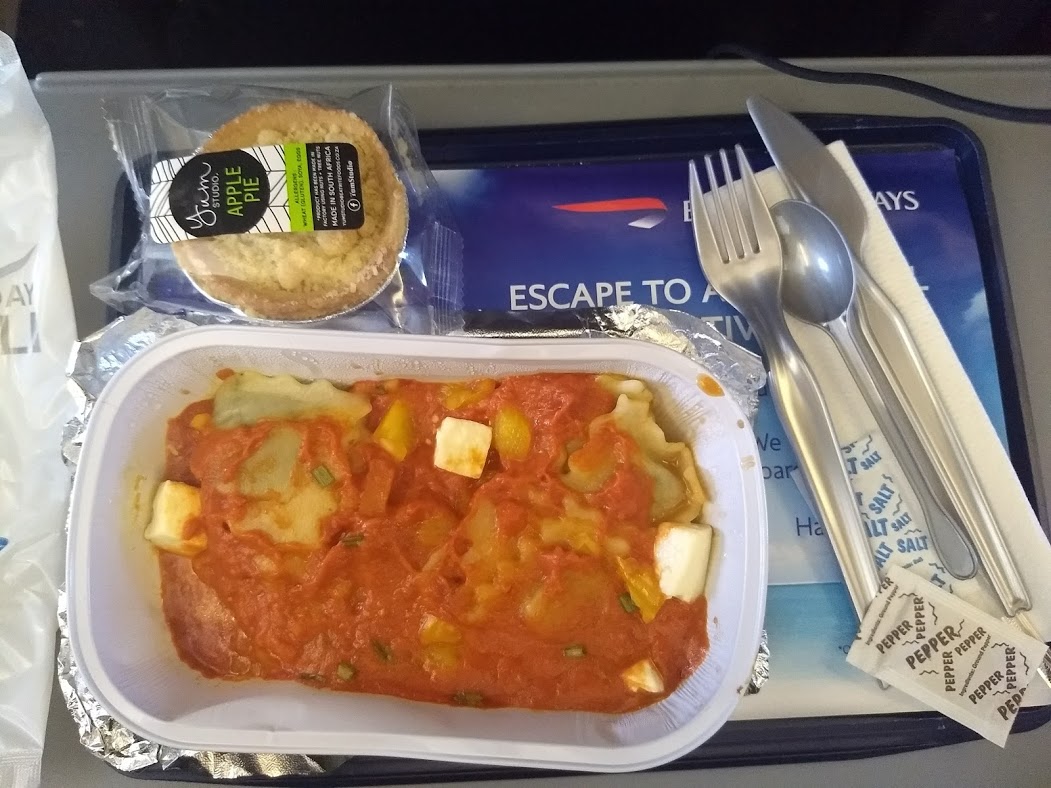
The aircraft was an older 737-800, originally delivered in 2002. It’s very much due for both a deep cleaning (there was set-in grime) and a cabin refresh; European BA cabins look a lot nicer but they also have been refitted with newer slimline seats while this aircraft has not been. The flight was almost completely full and only two hours long but the flight attendants still managed to get out a beverage service, a hot lunch, and a second beverage service.

airline meal picture

Spinach ravioli with feta, with apple pie accompaniment

One really annoying thing about flying to or within South Africa is the electronics rules. Held over from the early 2000s, airlines are absolutely zealous about allowing no use of portable electronics at all for completely unreasonable lengths of time. I was using my tablet and listening to headphones, and the flight attendant came by, scolded me, and made me turn everything off the moment we started descending. It’d be great to see South African aviation authorities retire these outdated and antiquated rules like most of the rest of the world has done.

Bottom line

While I don’t think it’s worth paying extra to fly British Airways in South Africa, I wouldn’t hesitate to fly them again. They got me to my destination safely, on time, with my bags, and I wasn’t hungry when I landed. And I got miles in my preferred frequent flier program (Alaska Airlines Mileage Plan)

Points I redeemed

The trip would have cost $78.39 in cash, but I redeemed 5,226 Chase Ultimate Rewards points. Yes, I realize that this was only 1.5 cents per point in value. However, this was far better value than the 7,500 Avios (plus $42 in taxes and fuel surcharges) the flight would otherwise have cost. In addition to this, I will receive 500 Alaska Airlines Mileage Plan miles for the flight (it’d only qualify for 125 Avios or American Airlines points because of the fare class I bought, but Alaska has a 500 mile minimum credit per flight). Although I might theoretically get some better value by preserving optionality for a future flight, this is a flight I wanted to take right now, it’s cash I didn’t want to spend right now, and it was available at the real price (not some arbitrarily higher price as is often the case) on the Chase portal. So to me, this was a no-brainer.

Ringing In The New Year In St. Helena

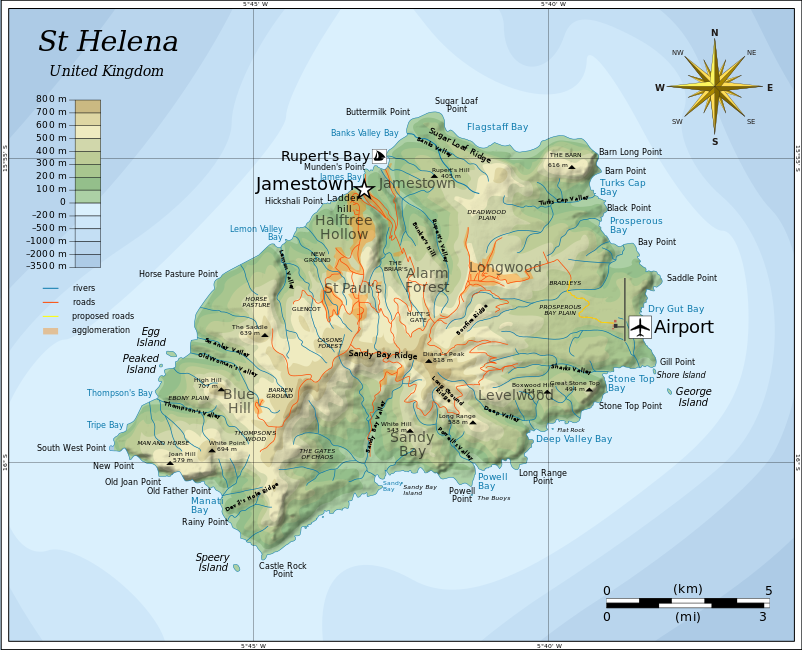
The island of Saint Helena is one of the most remote places in the world. Until two months ago, the only way you could visit the remote British territory was by private vessel or by taking the Royal Mail ship RMS St. Helena. It’s a very long journey across the stormy South Atlantic, taking 5 days each direction. The nearest mainland is Namibia, over 1,200 miles away.

map of st. helena

A tiny island in the middle of nowhere.

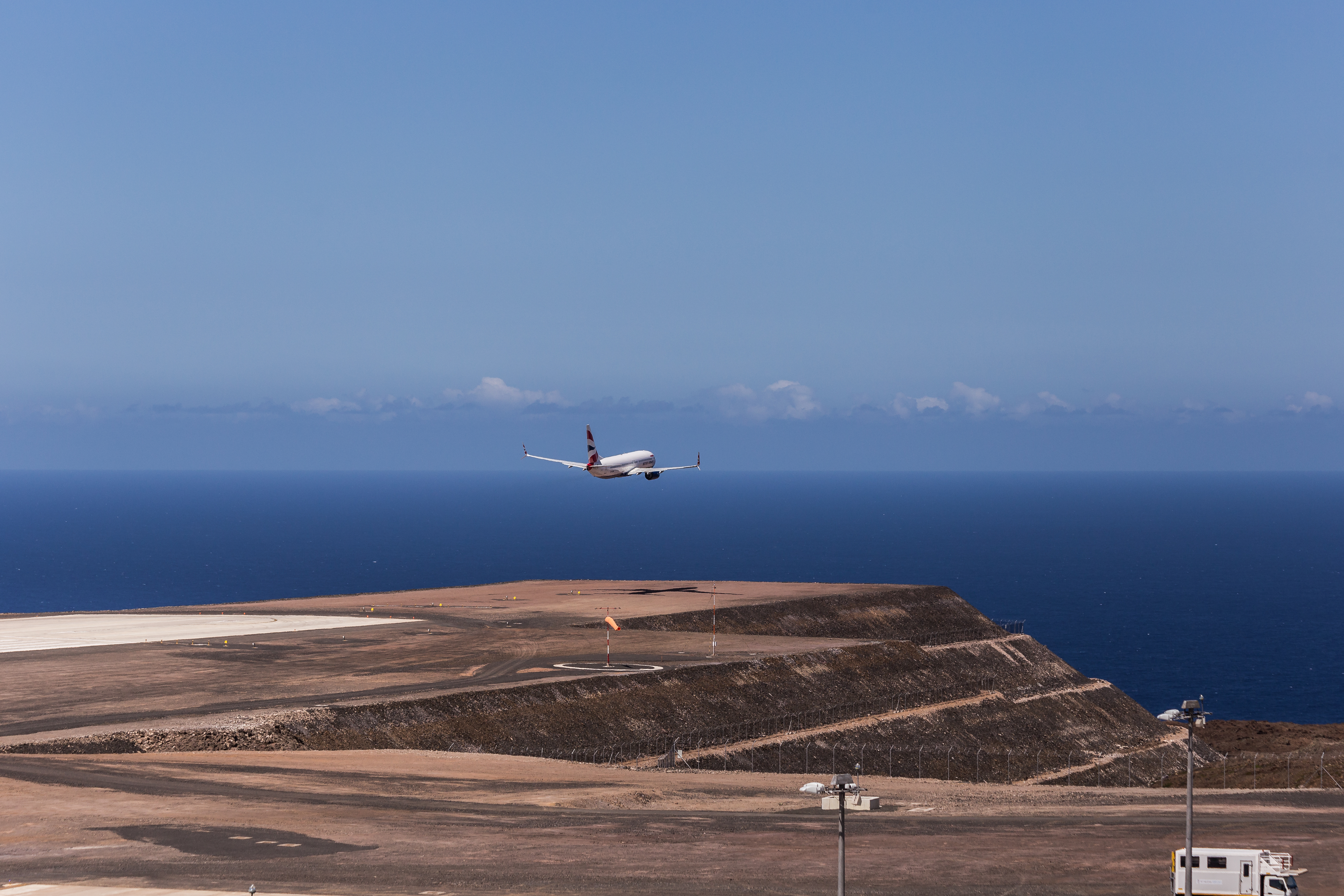
Two months ago, an airport finally opened in St. Helena, the world’s newest commercial airport (airport code HLE). It took 12 years to build from the time it was originally approved, because of the challenging terrain. The airport was spectacularly expensive costing over $400 million (around $100,000 per resident of St. Helena). Making matters worse, after the airport opened, authorities figured out that the aircraft type for which it was built couldn’t safely land due to wind shear. The largest aircraft that can land is a regional jet, and these can’t be fully loaded.

St. Helena airport runway

This isn’t the plane I’ll be flying to St. Helena, because qualification tests for this aircraft type failed.

This throws a monkey wrench into the already dubious plans for the airport to create a tourism industry on St. Helena. Because of the high operating costs, flights there are crazy expensive. I’m flying roughly the distance of a roundtrip from Seattle to New York (a trip I can easily buy for $400) and my ticket cost a cool $1,175 in points. Additionally, there is only one flight a week, meaning once the plane leaves, you’re stuck on the island for a week. But that’s OK, once you’re there, you can make satellite phone calls for $1.60 per minute.

JNB-HLE-WDH-CPT map

The most expensive flight I’ve ever bought

Naturally, this is the best place I could think of to ring in the New Year so I’d like to invite my readers to join me. I’m leaving from Johannesburg to St. Helena on December 30, 2017 and returning January 6, 2017. It’s normally very hard to get to Johannesburg on points, but not if you book last minute–I was able to use my Alaska Airlines Mileage Plan points to score a first class ticket on Cathay Pacific (an unusual thing for me to do but also a no-brainer; it’s 50k points in economy class and 70k in first class). The easiest way to buy tickets onward to St. Helena is on the United Web site (even though the flight is operated by Airlink, a South African Airways regional affiliate). Right now, the cheapest tickets are $1,264. Because the airport code HLE is new and isn’t loaded in most travel agency computer systems, it’s surprisingly hard to book tickets to this destination.

Note that there is only one flight per week, on Saturdays, so the shortest period of time you can spend on the island is one week. I don’t expect anyone to actually show up, but if you do, I’ll buy you a drink! 🙂

Are you joining me for New Year’s Eve in St. Helena?

How I Hacked My Trip To Sunny SoCal

On my recent trip to Minneapolis, I was originally planning to return directly to Seattle on a nonstop flight with Alaska Airlines. However, after shivering in the frigid temperatures and looking at the terrible forecast for Seattle, I decided that it might be better to head somewhere warm.

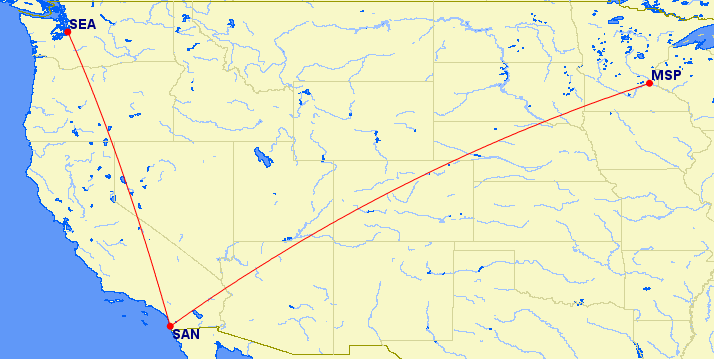
Alaska Airlines has really been adding a ton of service to San Diego lately, and I was delighted to see that nonstop service from Minneapolis was starting the day I was leaving Minneapolis. Even better, saver level award space was available. This opened up a great opportunity for me because it was close to the Thanksgiving holiday and award space was very difficult to find. So I hatched a plan: fly to San Diego, rent a car, drive to LA, get an airbnb for a week, visit friends, drive to Phoenix for Thanksgiving with family, then back to San Diego, and finally, a flight back to Seattle.

msp-san-sea image

Two flights. One award ticket.

Well, the first order of business was changing my flight. I already had a flight booked from Minneapolis to Seattle using British Airways Avios. This had cost 10,000 Avios and $5.60 in taxes. However, if I simply changed the ticket with Avios, it’d cost a $55 change fee plus the difference in miles (another 7,500 Avios). British Airways charges per flight based on distance with a minimum cost of 7,500 points. This obviously wasn’t the optimal solution.

However, British Airways offers another option: you can cancel your flight and redeposit the Avios. This also costs $55, but there’s a loophole: the $55 is deducted from the taxes and fees already paid. If you cancel online, British Airways won’t refund any fees, but also won’t charge any additional. So, in effect, you can cancel domestic US flights booked with Avios for $5.60.

Given that I was flying Alaska Airlines, another option was to book with Alaska Airlines Mileage Plan. I typically don’t book Alaska flights with Mileage Plan miles (using them for partner redemptions instead), because most Alaska flights are short to mid-haul and are thus cheaper with the Avios award chart. However, Mileage Plan has a very unusual benefit: they allow a stopover on a one-way trip.

What does this mean? Alaska treats a trip from Minneapolis-San Diego-Seattle as a single ticket, even if you stop over for 10 days in San Diego. And if you can find space at the lowest award level, it means the trip costs only 12,500 miles. Stopovers are specifically allowed under Mileage Plan rules and while most people don’t take advantage, it’s an entirely legal and risk-free “hack.” The catch? You have to find “saver” level award availability (in economy class, “W” fares) for the entire journey. Your trip must be entirely on Alaska Airlines where a domestic stopover is involved (on partner awards, stopovers are only permitted in international connecting cities). And you can only take a stopover at a logical connecting point. San Diego was a logical connecting point for my trip from Minneapolis to Seattle, because it’s in the correct direction of travel and doesn’t exceed the maximum permitted mileage. Alaska does have some measures in place to prevent illogical connections, such as Minneapolis-Portland-Los Angeles-Seattle.

It’s not just in San Diego where you can take a stopover, and people in the Lower 48 probably aren’t the biggest users of stopovers. This is a really valuable benefit for folks in rural Alaska who often get stuck in Anchorage overnight before they can fly onward to anywhere. Without it, they’d effectively be unable to book award tickets to anywhere other than Anchorage. Additionally, many folks traveling from Alaska to the Lower 48 stop over in Seattle for shopping before heading home. Everything costs more in Alaska so this makes plenty of sense. The Tukwila Costco is strategically located near Sea-Tac Airport and I’d be surprised if at least 10% of its business isn’t Alaskans.

san-ont-phx-san

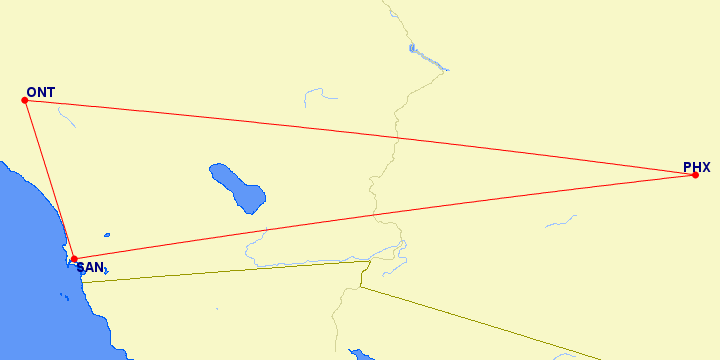
724 miles by air… and quite a few more by car.

Fortunately, the same benefit extends to those of us in the Lower 48, even at relatively new “mini hubs” like San Diego. Now, I’ll be completely honest: taking advantage of the stopover benefit did cost me money I wouldn’t otherwise have spent. After all, I was really going to Los Angeles and Phoenix, not San Diego. This meant I had to drive 100 miles farther than I wanted, but I did it in a rental car that was less expensive than it would have been in Los Angeles. I also had to overnight in San Diego versus flying out the day I wanted to leave, but the $35 hotel room I bought on Hotwire was cheaper (by far) than buying a flight. There were definite trade-offs, but I think they were worth it for the savings. And spending some time in San Diego, a city I often overlook, gave me the opportunity to reconnect with a friend I usually only see once a year.

The upshot? Look for new routes when you’re looking for award space. These are often wide open with saver level award space, even when most routes have been booked up for months around a busy holiday period. And if you’re flying on an Alaska Airlines Mileage Plan award ticket, don’t overlook the value you can get out of a stopover. This is a huge benefit. It’s one that really differentiates the program from its competitors (most of whom have taken away the ability to do this), and stopovers can really make an award trip more fun!

Don’t Be Frustrated By Baggage Friction

Until recently, the majority of airlines had baggage transfer agreements (with the notable exception of Southwest). What did this mean? Provided you weren’t flying Southwest (who did not and does not have agreements with any other airline), you could check in with the first airline in your itinerary and ask them to check your luggage all the way through to the final destination. This was even the case with airlines that weren’t partners (such as United and Delta) and on itineraries involving more than one ticket.

I’m not sure how the airline economics work, but apparently there is some cost involved when bags are transferred between airlines. Over the years, airlines have locked down baggage agreements to the point where the majority of the airline industry looks a lot more like Southwest than previously. The upshot? If your itinerary isn’t all on one ticket, you’re probably going to have to claim your bag and re-check it.

picture of bag with tag

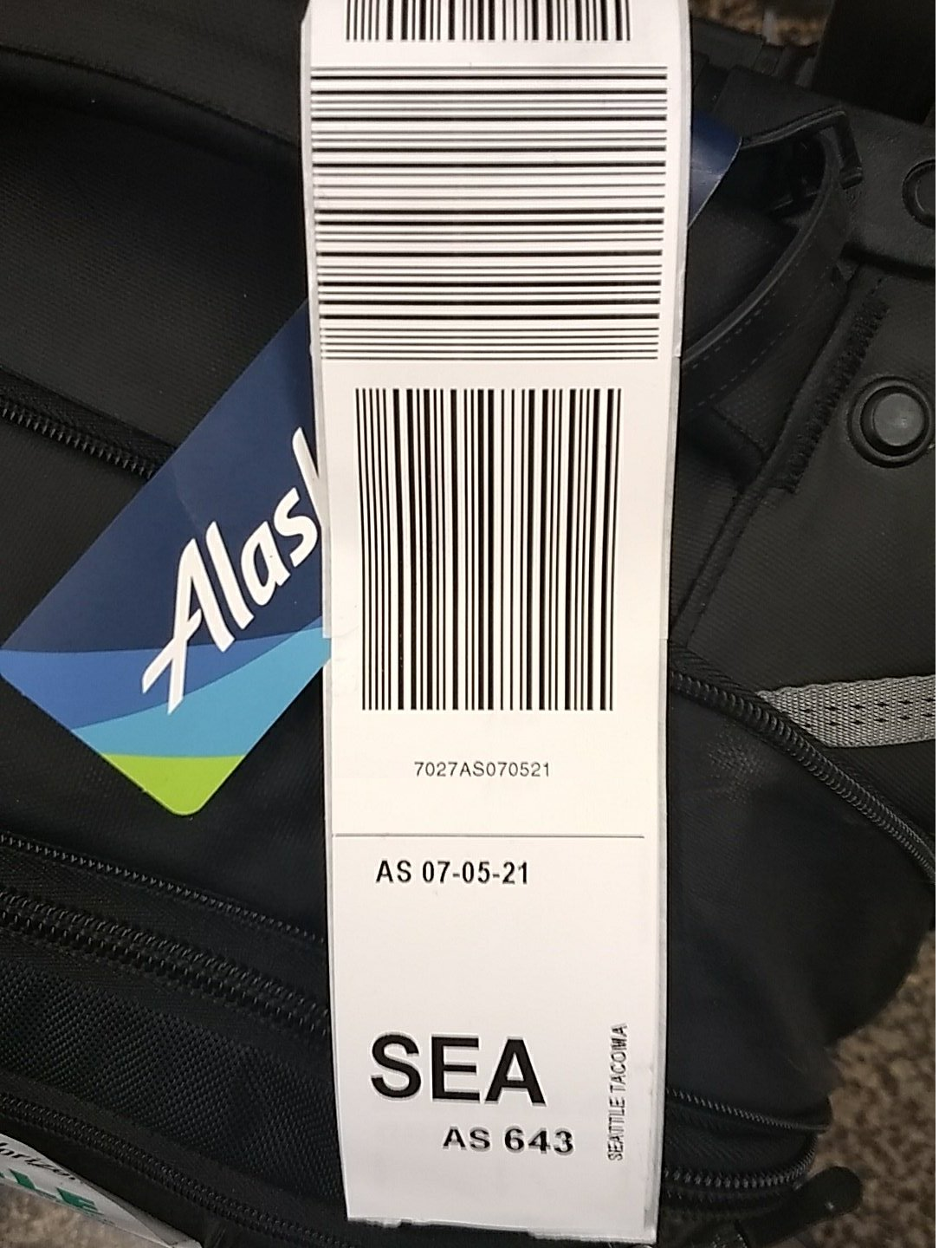
I had to re-check my bag in Phoenix to Seattle

I was just (unexpectedly) bitten by this problem by American Airlines. I’m flying American to Phoenix, and Alaska onward (on a separate ticket) to Seattle. Although American and Alaska are partners, American won’t always check a bag all the way through if you have more than one ticket on the itinerary. Sometimes they will, but it’s inconsistent. In fact, American won’t even necessarily check bags through all the way on their own airline anymore!

How can you be bitten by this problem? It can happen when you buy tickets through sites like Kayak, Momondo or Skiplagged. Many of these sites piece together an itinerary by booking a journey as separate tickets. After all, this can be significantly less expensive. My itinerary is a bit unusual, in that I’m combining an award ticket from Mazatlan to Phoenix with a paid flight from Phoenix to Seattle. However, the award ticket would have been expensive if I’d paid cash (it’s an international flight from Mexico during the shoulder season of a holiday period) and the paid flight was really cheap. It’s the same principle with paid tickets. A ticket from Seattle to Detroit via Chicago might be really expensive if you bought a through itinerary with American, but could be much less expensive if purchased as a Seattle-Chicago and Chicago-Detroit itinerary.

To punish you for saving money (there is really no other explanation I can see when only one airline is involved – if the intent is to charge you two bag fees, they could just collect them up front), American won’t check your bag all the way through. Instead, they’ll force you to claim your bag in Chicago and re-check it. This will require you to clear security again as well. There’s no good reason for this; it just introduces friction that doesn’t need to be there. What’s also odd is that this policy is inconsistent. American will allow you to combine a paid flight with an award flight booked with AAdvantage miles. However, they won’t allow you to combine a paid partner flight with an award flight, and they won’t allow you to combine a paid flight with an award booked on American through a partner (such as British Airways). And this is what just tripped me up. I assumed that the policy of combining a paid flight with an award flight would cover me, but it didn’t because the paid flight I’m taking is on Alaska Airlines (a partner flight) and the award flight I’m taking (on American) was booked with British Airways Avios.

Also bear in mind that I’m relatively expert at this stuff. Even I get tripped up sometimes. The average person, who doesn’t spend roughly 20 hours a week keeping on top of airline policies like I do, doesn’t have a chance.

What can you do? The only way to be (probably) sure that you’ll be able to check a bag all the way through to your destination is to book directly on an airline’s Web site and to book a ticket directly from your origin to your destination (without manual connections). Otherwise, build time into your schedule to claim and re-check your bags and re-clear security in connecting cities. It’s annoying, but not surprising. Full service airlines have been removing almost every last vestige of differentiation between themselves and low cost carriers. It’d be interesting to see low cost carriers go the other direction; when major airlines are creating so much friction that doesn’t need to be there, it stands to reason that they might see an opportunity for differentiation.

And of course, the other option? Travel light. None of this applies if you only have a carry-on bag!

Using Award Travel For Boring Trips

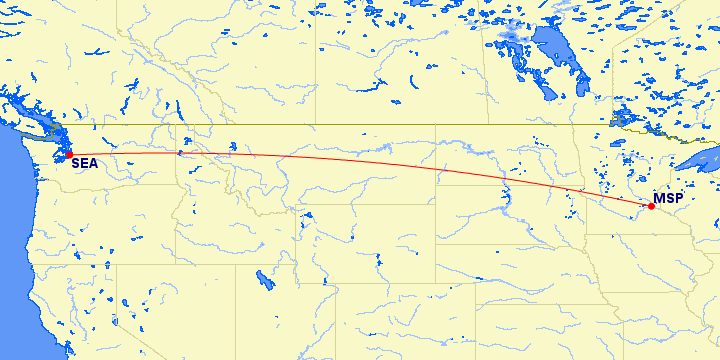
It’s November, and I need to take a trip to frigid Minneapolis next week. It’s a boring trip to a cold, boring city. I wasn’t particularly excited about going in the first place, and was even less excited when I saw the price. For the times of day I needed (it’s a tight schedule), I was looking at paying more than $600.

I need to fly out in the morning, fly back in the evening, it’s over a weekend – so I’m breaking all the rules of getting a cheap ticket. Cheap flights are the ones nobody wants to take, but if you want to take a flight at a good time of day it gets expensive in a hurry. Given that I went all the way to Fukuoka, Japan for under $600 it was pretty galling to see that the price for the schedule I wanted cost over $600!

cost of flight sea-msp

The outbound cost over $316… adding insult to the injury of a 6:45AM flight.

…and the return cost almost $300!

Less desirable schedules were possible for considerably less money, but in this case “less desirable” meant flights where I’d lose two entire days on the ground. This meant that I’d have to extend my trip to frigid Minnesota in exchange for a lower fare, which to me was a non-starter.

I didn’t expect that, with barely more than a week until travel, I’d be able to find a good value traveling with miles. Airlines have gotten pretty good with revenue management and these days, they give away far fewer seats (one reason why using an award booking service like ours is worth considering). However, this trip illustrates that it’s always worth checking! The Delta flight that cost over $316 was available for just 12,500 SkyMiles in economy class. And the Alaska flight that I wanted was available for 12,500 Alaska miles in economy class.

On its own, this would have been a pretty good deal, delivering about 2.5 cents per mile in value for the Delta flight (more than double what The Points Guy says they’re worth) and about 2.4 cents per mile for the Alaska flight (a nice bump above the 1.9 cent per mile valuation). However, I was able to get even better value than this by using British Airways Avios to book the Alaska flight. I scored a massive haul of these earlier in the year, and the Avios award chart prices flights by distance and number of segments.

Minneapolis to Seattle is a nonstop flight (which is important, because British Airways Avios charges per flight to calculate the cost). And clocking in at 1,399 miles, this trip costs 10,000 Avios based on distance. I was able to net nearly 3 cents per mile in value for my Avios points, which I think is exceptionally good. It’s exactly double what Avios are commonly considered to be worth.

These tickets are in economy class. This isn’t some theoretical valuation based on a premium cabin ticket I’d never buy, it’s a flight I would have bought with cash (although in all fairness probably at less convenient times, on different airlines, and involving connections in order to save money). On the airlines I’m flying, I’ll be able to take advantage of credit card benefits to check a bag, and award tickets aren’t considered “basic economy” fares so I’ve been able to select my seats in advance. More importantly, though, I have been able to choose exactly the schedule that minimizes the amount of time I have to spend in Minnesota in November! And that’s the very best savings of all.

How To Use Miles To Escape From Irma

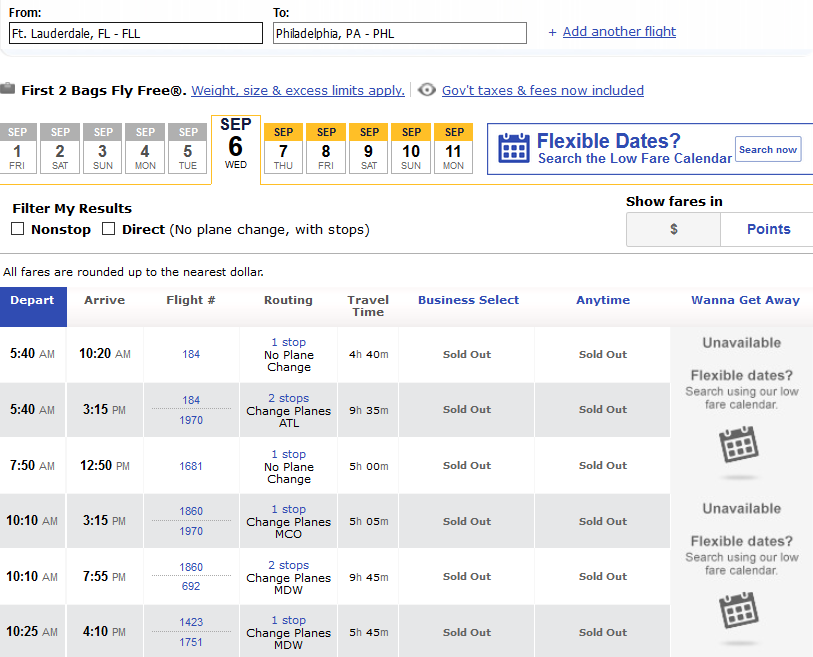
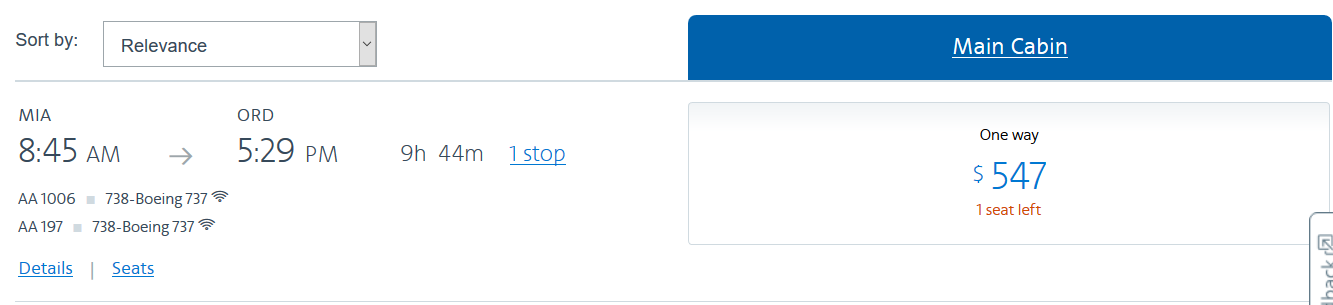
If you live in Florida, you’re probably looking at Irma and wanting to get out. However, a lot of other people already had the same idea and now flights are looking like this:

sold out

Southwest is sold out

Or this:

holy smokes that's expensive

It’s available… if you can afford it

So what can you do if you want to escape the hurricane? Look at some other options.

For all flights, American Airlines is honoring its “last seat” pledge and making seats available to AAdvantage members at the “standard” price. These awards are very expensive, at 20,000 points. Normally I’d never recommend booking one of these, but this is actually solid value for an “hurricane flight” at over 2.7 cents per mile in value. As of this writing, there is still one seat available to each of Dallas and Chicago on 9/6/17.

Alternate airports

While most flights out of the primary South Florida regional hub of Miami are booked, there are still a few seats available on flights from Fort Lauderdale.

Non-US Locations

Another option to evacuate south Florida with points is with jetBlue TrueBlue points, but you’ll also have to leave the country. TrueBlue points can be redeemed at a fixed value toward flights. While most jetBlue flights are sold out, there are a few seats left on their Fort Lauderdale to Mexico flight. Don’t have any jetBlue points? They transfer instantly from American Express Membership Rewards.

Fort Lauderdale to Mexico award pricing

When you need to leave the country immediately, jetBlue has you covered

Cash Deals

Last-minute walk-up fares are pretty expensive for international flights, but jetBlue is duking it out for supremacy with Aeromexico. Both forgot to raise their fares on this route during the hurricane crisis, so you can book the closely timed Aeromexico flight out of Miami for a little over $300 right now. This is one of the cheapest ways out of the region.

Another good way to fly is to look for codeshares on international carriers. Air Canada has a codeshare on a United flight from Fort Lauderdale to Los Angeles via Denver. If you can find it (I use Momondo for my searches) you might be able to get out for about $200, instead of $2,000.

Bank travel portals (for spending your bank points) aren’t a good way to get out right now. They are showing prices even higher than the airlines. It’s best to just pay cash if you want to get out and can’t use points another way.

General Advice

Look for routes off the beaten path. You might need to get creative with routings and look at places like Panama City, San Salvador or even Madrid as possible evacuation points. It’s already tough to get a ticket at all, so don’t waste time booking.

Airports are going to be a complete zoo so show up many hours before your flight. Don’t expect the airlines to be able to re-accommodate you if you’re late. They won’t have any flights. By this weekend, everything will be shut down.

How I’m Maximizing Distance Based Awards In 2017

For a long time, most US airlines charged 25,000 miles for a saver level domestic round-trip award in economy class. This is a number that stayed the same for literally decades. Airlines cut availability of saver level awards, introduced additional higher level pricing tiers with more availability, and made one-way awards available, but one principle remained the same: with few exceptions, the price was–more or less–12,500 miles whether you were flying from Seattle to Portland, Oregon or Portland, Maine.

Some “hacks” were available, but they were limited. For example, British Airways Avios offered (and still offers) a distance-based chart that charges per flight. For short-haul flights of 650 miles or less, they charged just 4,500 miles (this award tier has been eliminated in North America, and now all flights up to 1,150 miles cost 7,500 miles). This is still great value, but it only applies on non-stop flights. Flights with a connection will cost you at least twice as much.

sea-sfo-las graphic

A nonstop flight from Seattle to Las Vegas costs 7,500 Avios. However, connecting in San Francisco will set you back 15,000 points!

Well, a lot has changed in 2017. Delta got rid of its award chart entirely, and there are now some great values on it if you know where to look (along with some terrible values too). Alaska massively revamped its award program, but was much more transparent with the changes than Delta. American got into the game by introducing a new short-haul award, and even United has an anemic offering in its award program.

Delta

A couple of years ago, I ended up with a massive haul of Delta points through a promo they ran with American Express. The only problem was using them. The Delta SkyMiles program has been much maligned over the years, and deservedly so. Delta was historically stingy with award availability, making it hard to use SkyMiles. Then they introduced an insanely complicated award chart with as many as five different pricing levels. Awards went from being almost impossible to obtain to available, but incredibly expensive.

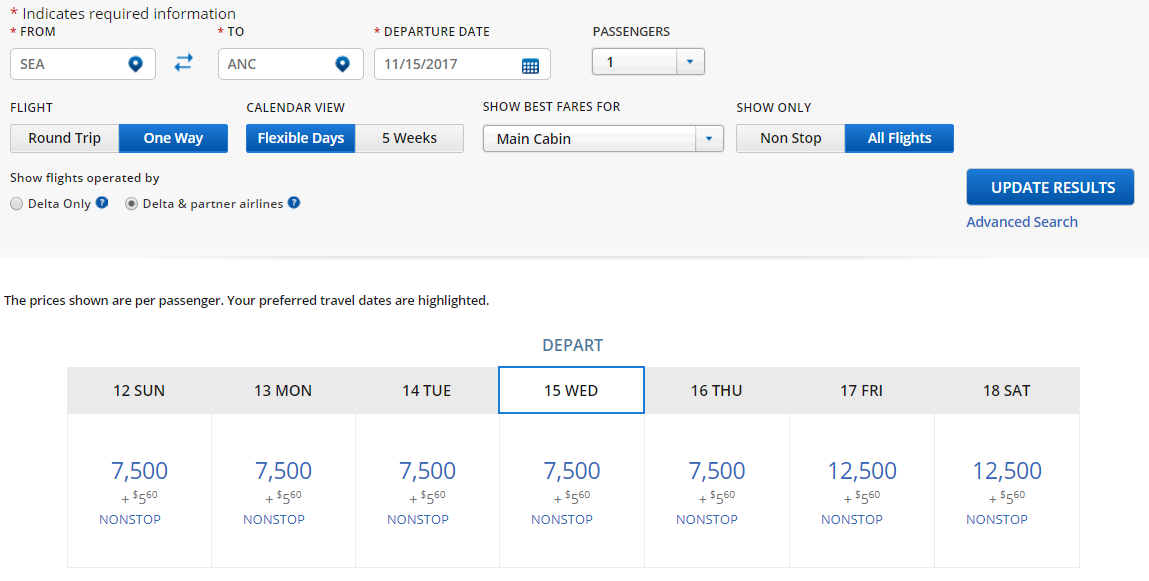
Eventually, Delta got rid of its award chart entirely. Most people assumed that it would result in a price increase for most flights, and for awhile, that was true. While prices have gone up for many flights, they have–surprisingly–come down on a lot of flights too. There doesn’t seem to be a whole lot of rhyme or reason to it, but short-haul flights can be priced from 5,000 to 7,500 miles when booked in advance.

What’s more, the pricing may be loosely based on the revenue fare, but also seems to be based on demand for the flight. Seattle to Anchorage is a $140 paid flight, so redeeming SkyMiles yields a value of about 1.8 cents per mile.

SkyMiles award chart for Anchorage

Anchorage is a mid-haul flight of 1,449 miles – but it’s only 7,500 SkyMiles on select dates.

I am using my bank of SkyMiles for flights to Alaska (I recently redeemed 7,500 SkyMiles for a flight to Juneau) and for flights to Los Angeles (I just redeemed 5,000 points for a flight to LAX). In all cases, I have realized an equivalent cash value of over 2 cents per point, which is very good for SkyMiles.

American

American’s AAdvantage award chart is largely theoretical because there is so little award availability anymore. That being said, short-haul flights of 500 miles or less to the US or Canada are allowed for 7,500 miles.

If you’re stuck with a lot of AAdvantage miles and want to use them for short-haul flights within North America, focus on Canada. 500 miles can get you from most of the East Coast to Toronto or Montreal. These would often be very expensive flights otherwise. Given that American allows you to take a connection en route to your destination (while BA charges you per flight), this might be a better option if you can hold the overall distance traveled to under 500 miles.

United

United has, for many years, offered a short-haul award of 10,000 Mileage Plus points for up to 700 miles traveled. However, this just isn’t much of a savings over the 12,500 mile level for longer flights. Since the difference in cost is so small, the calculations really don’t change substantially versus a 12,500 mile saver level award. Generally speaking, United short-haul awards are poor value.

Alaska

Alaska Airlines revamped their award program at the beginning of this year. There was a lot of breathless coverage at the time along with a lot of silly hacks people published taking advantage of loopholes in the pricing engine (which have since been closed). While some of the changes were negative (the biggest being the loss of Delta as a redemption partner) others were largely positive, such as the move to a distance-based redemption chart. This exposed some sweet spots that have largely escaped the attention of mainstream travel blogs, but they didn’t escape my attention.

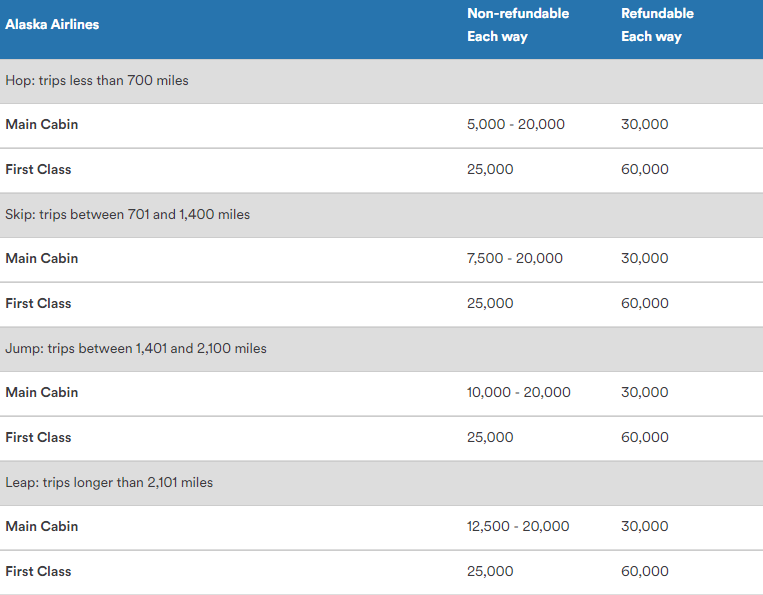
As good as short-haul awards are on Alaska, I haven’t personally been using them. First of all, they’re hard to come by because Alaska’s chart is variable. Although in theory, you can find awards at the lowest level published, in practice they’re hard to get:

Alaska mileage chart

Although you can find Alaska awards at the lowest levels, it’s not consistent.

For example, it’s under 700 miles from Seattle to Ketchikan. Good luck finding an award at the 5,000 mile level though. I did find a couple – on December 23, for example. Merry Christmas! These awards do exist, but a more common redemption level is 20k which is more in line with what flights to Ketchikan cost.

Unlike most programs, Alaska allows a stopover on a one-way award. This is such a valuable benefit that I always try to maximize it when using their program. However, adding in a stopover seems to consistently drive the price up to 12,500 miles (and this is guaranteed to happen when a partner is thrown into the mix). Accordingly, given my usage pattern and the flying I like to do, it really only makes sense to redeem Alaska miles for long-haul domestic awards in economy class or long-haul international awards in business class (with some exceptions; partner awards on American are also particularly good value off-peak).

Southwest

The Southwest chart isn’t distance based, but it’s worth pointing out that it can be highly competitive with distance-based airline award charts. Southwest awards are based on the price of the flight, not the distance traveled. However, for some flights, this creates a sweet spot. For example, flights from Seattle to Tucson are over 1,200 miles which would push an award into the mid-haul Avios chart (at 10,000 points required). However, Southwest regularly offers sale fares between the two markets and you can sometimes redeem Rapid Rewards points for much less. The same is true with flights to Phoenix and Los Angeles. These are very competitive markets and the fares are low, sometimes as low as $59 each way. With Rapid Rewards holding a pretty steady value of 1.7 cents per point (sometimes more, sometimes a bit less) it’s always worth comparing Southwest to an economy class short-haul distance based award. You may find that Southwest offers better value.

Combinations

One “sweet spot” I have found is also a risky one: combining multiple short-haul award flights. I’ll explain how I did this with my friend Boris on an itinerary to Mazatlan this December.

I am always on the lookout for new routes (since this often means award availability) and American Airlines (a British Airways partner) has recently increased their flying to Mexico via their regional partner Compass Airlines (which, oddly enough, has its roots in Delta-acquired Northwest Airlines). It’s 1,046 miles from Los Angeles to Mazatlan which puts the LAX-MZT flight in the 7,500 mile band with British Airways Avios. American’s flight from Mazatlan to Phoenix is also in the 7,500 mile Avios band, at 789 miles. So both flights are right in the “sweet spot” with the Avios program.

What’s more, these are expensive flights to a popular beach resort at a busy time of year. It’d cost over $500 to buy the tickets! Granted, there is quite a bit of tax built into the fare (which you have to pay in cash when booking with miles) but you can realize about 2.3 cents per mile in value when booking these flights in economy class.

Availability is always tough with American but Boris and I found two seats outbound from LA on December 8th. On the 16th, there wasn’t availability for two from Mazatlan to LA, but there was for one person, and there was another ticket available from Mazatlan to Phoenix (for one person) leaving an hour later. Boris was returning to Los Angeles, but I can connect back to Seattle just as easily through Phoenix so we agreed to split up on the return. So, here are what my flights look like, for just 15,000 Avios:

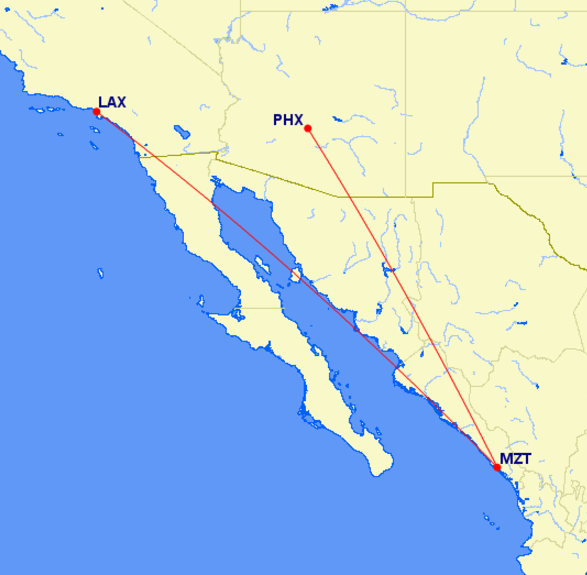
lax-mzt-phx map

These short-haul flights cost just 15,000 Avios. They would have cost over $500 in cash.

Of course, I’m not starting my trip in LA, and I’m not ending it in Phoenix. I needed to book connecting flights. Unfortunately, there weren’t any available on the day of travel that would get me to Los Angeles in time, so I ended up flying a day earlier. For me, though, that’s actually fine. I have a lot of friends in LA, so I was happy to schedule an extra day there.

How did I do it? Delta. There was a 5,000 mile nonstop award between Seattle and LAX. This flight would have cost $106, so I got a very solid 2 cents per point.

For the return, I initially booked a Southwest award at a very solid 1.8 cents per point in value based on a $130 fare. However, this ultimately wasn’t great value, because Alaska Airlines put a flight on sale leaving at almost exactly the same time. I had a $75 e-certificate that was due to expire, and using this brought the fare down to under $25 in cash. Considering that I’ll earn 1107 miles on this fare, and I can regularly get 2.2 cents per mile in value from Alaska miles, the ticket is actually free–it’s actually a better deal than using points.

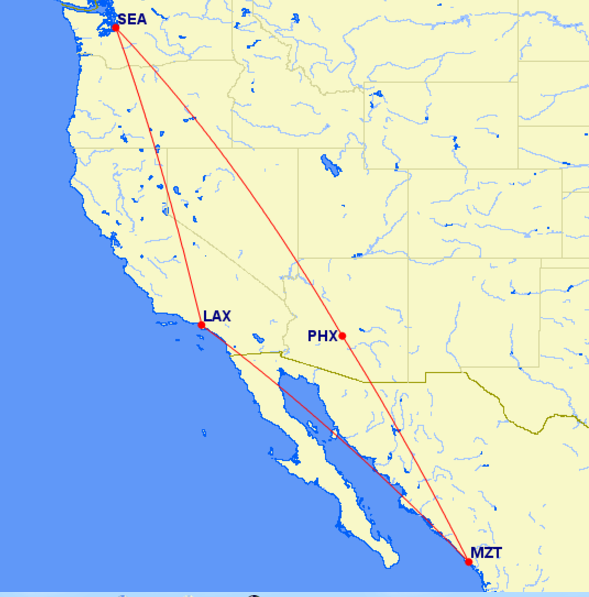
sea-lax-mzt-phx-sea

3,896 miles of flying–for just 20,000 points redeemed.

What’s the risk with a “hack” like this? The biggest one is on the return. If anything goes wrong with my flight out of Mazatlan, I could technically be stranded in Phoenix. This is because I’m traveling on two separate tickets. American only owes me a flight to Phoenix, and Alaska only owes me a flight from Phoenix to Seattle at the scheduled time. If I don’t show up for it, they don’t owe me a flight home. Additionally, American isn’t technically required to check my bags through all the way from Mazatlan to Seattle, even though I’m flying with their partner Alaska.

However, in practice, it’s sometimes possible to arrange bags to be checked through. And in practice, Alaska will usually put you on the next flight out if you misconnect, even if it’s not their fault. I’m leaving on the last flight of the day, but my family has a place in Phoenix, so I wouldn’t be sleeping on the airport floor overnight. I have a couple of friends in Phoenix, so can probably lean on someone for a ride. Ultimately, the best deals sometimes require taking a bit of risk, and my worst case scenario is burning some points to get out of Phoenix.

By optimizing my redemption of short-haul awards in economy class, I was able to achieve some very solid points valuations, all over 2 cents per mile, with hard-to-use points. And I got tickets to Mexico roundtrip from Seattle for just 20,000 points.


$99 Beijing Flights – With A Dangerous Catch

A startup called Airmule has recently made a big splash by offering $99 flights to Beijing. Obviously there’s a catch. The catch in this case is that you have to give up one of your checked bags (they appear to book you on carriers that allow two checked bags), and your other checked bag is a courier shipment. So, sharing economy, right? Seems like a perfect opportunity for a startup to move fast and break things. Most people don’t check two bags anyway so why not leverage this opportunity to make shipments of up to 50 pounds at low cost, with the fastest delivery possible?

Plus, you really have to love the founders of this company. I mean, as a startup founder myself, I’m rooting for them. One is a hardcore gamer, the other is a former backup dancer for Gucci Mane, and the third loves beer more than you do. I’m not making this up–this is what they say about themselves on their Web page:

Airmule cofounder photos

These guys totally have you covered.

So, despite the obviously strong qualifications in air cargo handling and logistics possessed by the founding team, the reason why I’d personally pass on this is that there’s a really big catch–one so serious it could potentially make you the star of an episode of “Locked Up Abroad.”

When you pass through Customs–particularly Customs in Beijing–you are personally responsible for everything that you bring into the country with very few exceptions. One of those exceptions is to be the authorized representative of a “common carrier.” These are companies like FedEx, UPS, or DHL, or the airlines themselves. Common carriers are considered by governments to be transportation carriers only. They aren’t held responsible for the contents of the shipments they carry; full responsibility lies with the people sending and receiving the shipment.

If you’re acting as an air courier, you may not have any of those protections. You could be fully liable for what you carry through Customs. So, that suitcase of apparel you’re supposedly carrying for a fashion show? If it’s loaded with heroin, that’s on you, and the penalty for that in China is death (no ifs, ands or buts). The suitcase full of baby formula? If you didn’t know that it’s illegal to bring it into China, it doesn’t matter: the massive fine is all yours if you get caught.

Airmule takes a bunch of reassuring-sounding security measures. For example, they participate in a TSA inspection program which verifies that shipments are safe for air transportation. You do too–by letting the TSA inspect your bag when you check it in (although in all fairness, there are some additional security measures cargo companies comply with, and Airmule says they do this). Airmule claims that they inspect shipments as well, and I think they probably do. However, while this provides reasonable assurance that whatever you’re carrying won’t cause the plane to crash, it doesn’t provide as strong an assurance that what you’re carrying is actually legal to carry into the country where you’re carrying it.

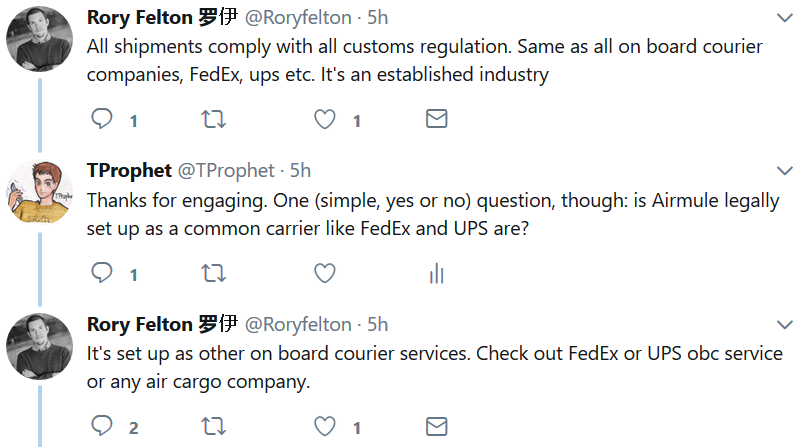
I reached out to Airmule to ask them to clarify who is liable for shipments. Just like the Airmule FAQ, I got an answer that sounded reassuring while skirting the question:

Evasive asnwer from Rory

This answer wasn’t reassuring.

So, I pressed for a clearer answer, and got one that is, to me, as clear as mud. I’ll leave it to you to draw your own conclusions:

Rory Is Evasive

I think this is a roundabout way of saying “No”

I lived in Beijing for 3 years, so know that there’s a legitimate demand for this sort of thing. There are a lot of goods that are imported into China through Customs gray areas: they can’t be imported commercially, but they can be imported in personal quantities. One example is certain food items. You’re allowed to hand carry quantities of foodstuffs that are in line with personal consumption or gift-giving, even if importers aren’t allowed to bring in these goods. Similarly, you can bring in bottles of alcoholic beverages that aren’t available in China using your personal Customs allowance. And baby formula is another popular item. You can bring in a limited quantity (the regulation is fuzzy and seems to currently be “as many cans as you can convince Customs is yours”) of foreign-made baby formula for personal use. Every time I left the country, I’d be deluged with orders from new mothers in my office–this is a very popular item given ongoing scandals about tainted milk powder sold in China.

Other stuff is less gray area and more considered to be smuggling. For example, Apple products cost about 40% more in mainland China than they do abroad, so they’re popular items to smuggle in luggage. Even something as innocuous as books could be a really major problem in China. Books and literature are closely controlled in mainland China. That suitcase full of Chinese-language books you’re carrying might actually be hardcore prohibited political speech that could get you in a huge amount of trouble. How good is your Chinese?

And then, there’s the issue of drugs. All you need to do is watch “Border Security” to see all of the inventive ways that drugs can be concealed. If the courier company you’re working with doesn’t figure out that the shipment you’re carrying is actually drugs, but border guards do, your cheap vacation could turn into the last flight of your life. China doesn’t mess around–drugs equal the death penalty and given their history of the Opium War, being a foreigner will get you zero slack. In fact, you’ll get less than a Chinese person would.

Being able to fly for steep discounts as an air courier isn’t a new thing. This is something that has been around for decades. It just hasn’t gotten very popular, because usually you’re going to places where express courier services aren’t able to operate easily (such as Burkina Faso). And there are all kinds of shipments, to all kinds of locations, where hand carrying an item makes the most sense–whether it’s transplant organs, life-saving medicines that require refrigeration, aircraft parts, or other critical shipments that just need to be delivered by the fastest route possible.

I really don’t want to come off as sounding unsupportive of startups, or of this team. I really love innovations that will help people travel and see the world for less. I am the founder of a dating startup myself (one where we’ve had to make some really tough decisions about the trade-offs between usability and security for our users–we have gotten it right so far, but I know it’s only a matter of time before we have a bad day). That being said, there is a massive amount of risk that 20 year old backpackers may be accepting in order to score a cheap holiday, and they probably don’t know that they’re undertaking this risk. As an air courier, you are–in a literal sense–putting your life in the hands of a courier company, and trusting your life and freedom with the integrity of whatever you are carrying for them. Take this seriously, check out the shipment yourself, ask lots of questions, watch a ton of episodes of “Border Security” to find out how inventive smugglers can be, and if you aren’t 100% sure…

…just walk away. A cheap ticket isn’t worth it.

UPDATE

One of the co-founders of Airmule isn’t happy with this article and disputes the facts as I described them. Since the facts about his service came from his own tweets and email I’m not sure where the dispute is, exactly, but I’m happy to correct the record if anything I have written is factually incorrect.

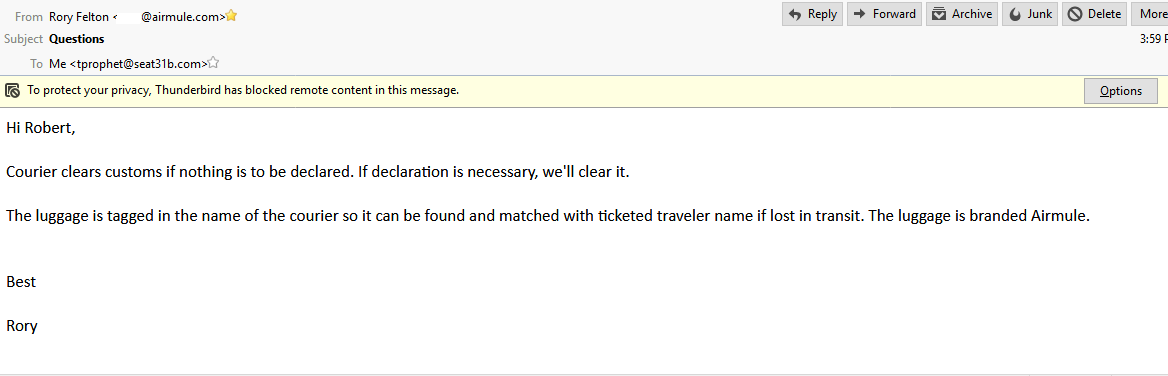
Rory Felton email

Here’s the email I got from Airmule answering my questions

Rory had the following to say on Twitter:

Notwithstanding the tone of the response–which is arguably justified if the facts are wrong–I have offered Rory and Airmule (and will offer the entire air courier industry) an opportunity to respond to any facts that I got wrong. Thus far, this hasn’t happened. Since calling me “unprofessional” and “lame” doesn’t really help to correct the record should any facts be in dispute, I do hope we can have a facts based conversation going forward.

EPILOGUE

Airmule ultimately didn’t dispute any of the facts in this blog post. In fact, their Terms of Service explicitly places full Customs liability with the person carrying the suitcase (many thanks to the helpful reader who pointed this out). NOTE: Airmule has stealth-edited their Terms of Service, the original is here.

Rory also claimed that the Terms of Service was out of date. I’ll leave this to the interpretation of the reader:

another lie

I’m not sure how to read this, but….

Would I personally do this? Not on my life! The risk is definitely not worth it.