Always Garden Your Reservations

We’re taking my niece to Scotland following her high school graduation this summer. While the rest of the family is navigating their own flights on a separate adventurous itinerary (including a stop in Dublin), I’ve been busy piecing together the routing for Rakhat and me from Vancouver.

Castles and monsters and bagpipes oh my!

My initial booking wasn’t great, although it has been a really tough summer to find award inventory so I was almost grateful to have anything at all. I managed to lock in YVR-CDG-EDI through Flying Blue for 105,000 miles and about $300 out of pocket per person. It was a steep price to pay for business class, but award space was tight and we needed a guaranteed way across the Atlantic.

Booked or not, the routing bothered me. Connecting in Paris during the peak summer travel rush is always a gamble, but our specific situation made it a massive liability. Rakhat travels on a Kazakhstan passport and doesn’t hold a Schengen visa. If everything goes as planned, an airside transit at CDG is perfectly legal. But if a flight gets canceled, an aircraft gets swapped, or a strike happens, the whole thing could quickly devolve into a complicated immigration issue. So yeah, Air France has nice champagne. We don’t drink, though, and there’d be no way to take the edge of the stress.

So, I kept gardening the reservation.

Last night, a much cleaner option opened up. British Airways did a massive inventory dump. Canada is officially in a recession now, and business class seats don’t appear to be selling. I was able to snag two seats to London via Cathay Pacific’s Asia Miles program. Even better, it was in BA’s updated Club Suites, costing just 63,000 miles plus $300 per person. Why did I use Asia Miles? This program discounts British Airways’ notorious fuel surcharges. I could have booked through Alaska or American for slightly fewer points, but it would have cost about $700 more per person in cash.

The obvious catch was that London isn’t Edinburgh. But instead of treating Heathrow as an annoyance to route around, we decided to lean into it. We could pull a day out of the Edinburgh itinerary, spend the day in London so Rakhat could see Big Ben, and fly up to Glasgow at night on easyJet. Why Glasgow? It’s a 45 minute train ride away from Edinburgh and this is the itinerary that worked, at a somewhat reasonable price.

Dumping the Flying Blue tickets cost us $150 in cancellation fees, and the easyJet flight added another $170. It wasn’t all bad news, though. We clawed back 15,000 Hilton points because our first night shifted to a cheaper property (with a free breakfast to boot). Because the transatlantic surcharges were essentially identical, the math was pretty clean: we saved 84,000 miles in exchange for a modest cash outlay and a cheap positioning flight.

More importantly, the entire Schengen transit risk evaporated. If easyJet melts down on the domestic leg, we are already inside the UK with plenty of backup train and flight options. We traded an unmanageable border control risk for a manageable domestic delay.

The British Airways inventory dump benefited our journey home too, although this required a different kind of surgery.

I originally booked economy class tickets from Glasgow to Vancouver via Gatwick, booked for 70,000 BA Avios and $150 each. I wasn’t wild about a 10 hour long economy class trip in British Airways’ high density “Gatwick special” configuration, but we needed an efficient route on a specific date and this was what was available. Besides, I reasoned, it was a day flight. Nevertheless, I kept monitoring the long-haul leg in case premium space became available.

When Club World inventory finally opened up on that exact Gatwick-to-Vancouver flight on which I was booked, I jumped on it using Atmos points. I would like to have rebooked the whole thing using Atmos points starting in Glasgow, but it simply wasn’t available from there; I could only start from London. The standard rate was 110,000 points, but applying the companion voucher from my Atmos Summit card knocked it down to 85,000 points, plus roughly $1,550 in cash. That’s a whole lot of cash, but it was in the trip budget. More importantly, it makes Rakhat happy. I don’t think there’s anything in the world he likes more than flying in premium cabins, with the possible exception of his cat Murka.

cat
Hardest worker in the household

The challenge was preserving the UK domestic leg. A standalone cash ticket from Glasgow to Gatwick was running an absurd $350 per person, so I couldn’t just scrap the whole Avios itinerary. Instead, I called British Airways to see if they could manually drop just the long-haul segment. The agent managed to do it, triggering a partial refund of 48,500 Avios and $186 after accounting for the $55 per person change fee (since I was unable to do this online, the friendly agent waived the telephone booking fee).

When you compare the old return to the new one, the incremental cost to avoid a long transatlantic flight in economy came down to 36,500 points and about $1,200 cash. I don’t measure these redemptions against the airline’s fake $11,000 retail cash fares, because I would never actually pay that. I measure it against the baseline I already booked. For a long flight home after a long family road trip, that premium is probably worth it.

The trade-off here is baggage. Because the domestic leg and the long-haul business class flight are now on separate tickets, British Airways won’t through-check our bags in Glasgow. We have a three-hour window at Gatwick to collect our luggage, ground-transport it to the international terminal, and check in again. It introduces some friction, but a domestic-to-international self-connect with a three-hour cushion is a completely manageable risk.

So, don’t walk away from an itinerary once the confirmation email hits your inbox. Keep looking. Award availability is fluid, and options that didn’t work during your initial search could open up. This may save your budget (or your sanity) a month later.
British Airways – Cape Town to Durban In Economy Class

One of the most unique parts of the British Airways operation is in South Africa. BA operates long haul flights from London to Cape Town and Johannesburg. However, they also have a branded domestic operation within South Africa (operating in all major cities) and a regional operation between South Africa and other destinations in southern Africa (Mauritius, Namibia, Zambia, and Zimbabwe). The flights are competitively priced versus South African Airways, although fares are usually a bit higher than low cost carriers (including Kulula, its affiliated carrier). And they operate a nonstop route between Cape Town and Durban, which is a route I wanted to take. Better yet, the flight was competitively priced versus the low cost carriers (I was able to book a sale fare) and even better than that, I was able to book the trip using my Chase Ultimate Rewards points.

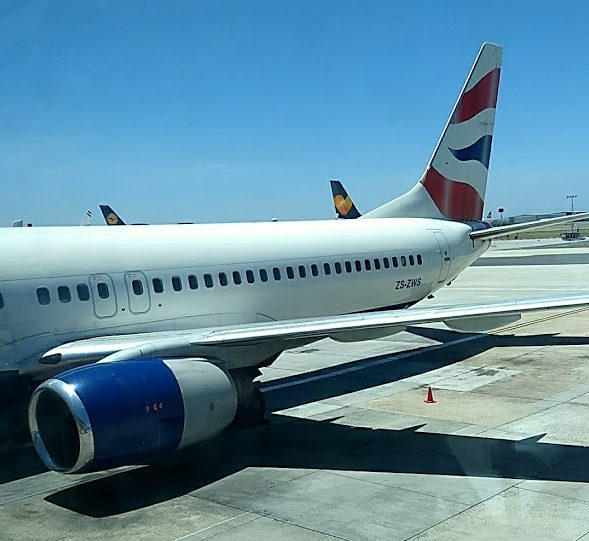
“But wait a minute,” you might be saying. “That’s cabotage!” And yes, it would be, except that BA actually operates via a franchisee in South Africa. The operating carrier is Comair. There is a decal on the front of the plane (which is easy to miss) that indicates this and the flight attendants announce “operated by Comair” when stating the flight number, but most people would have no idea that they’re not flying with British Airways. The branding, marketing, frequent flier program, uniforms, Web site and even the inflight magazine are all BA. In fact, the only thing that would tip you off that it’s not quite BA is the fact that in South Africa, BA remains a full service carrier.

BA operated by comair 737-800

You’d never guess that this British Airways aircraft is actually operated by Comair

While BA sells domestic European fares that don’t include a carry-on bag, and BA has also cut meal service on its intra-Europe flights, Comair has maintained British Airways as a full-service carrier. I’m not entirely sure why this is the case; maybe it’s because they want to differentiate the product from their own low-cost carrier Kulula, or maybe it’s because they want to be competitive with South African Airways (which is also a full-service carrier). It’s also possible that the franchise agreement dictates the services they’re required to offer. Nevertheless, the service is differentiated in a good way.

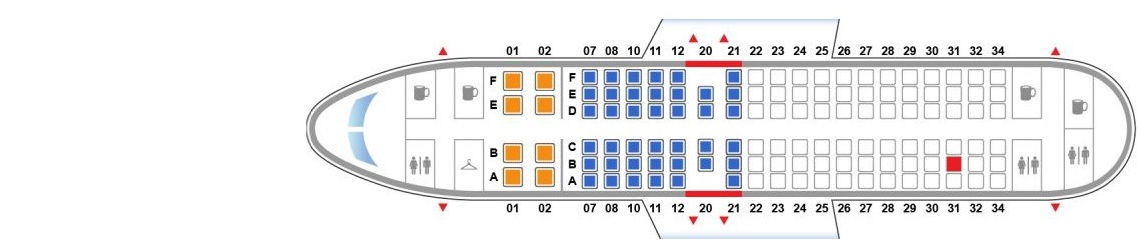
I boarded late, so didn’t get good pictures of the aircraft cabin. However, there are a few things that were interesting. The first is that the “Club” cabin is different than both US first class carriers and domestic European carriers. The seats have slightly more pitch than economy class. They are slightly wider as well. This means there are 5 seats across in “Club” class (3×2), versus 6 across (3×3) in economy class. On a US domestic carrier, first class would be 2×2 and on British Airways in Europe, “Business” class would be 3×3, but with the middle seat blocked out. I think that this configuration is interesting; it’s more like a premium economy class than a business class, but with a wider and more comfortable seat.

My seat was in economy class. Like the rest of the British Airways operation, you have to pay for seat selection until check-in. I wasn’t able to check in using the mobile app, so ended up checking in online late via the BA Web site. This meant that the only two available seats were the very back row (right up against the toilet) or a middle seat in the front. Since I am on the road I didn’t have (or have access to) a printer. However, that’s OK; British Airways lets you compete the check-in procedure online (so you can select a seat) and then print out a boarding pass at the airport.

When I got to the Cape Town airport to check in, I asked whether any better seats were available. There was an “exit row” available. However, the seat maps with BA are really strange about what is considered an exit row. The very last row of the plane–the one where all the seats back up against the toilets and don’t recline–is considered an “exit row,” because it’s close to the rear exit. However, this comes with none of the benefits. In my case, I was given a seat in the row in *front* of the exit row, which isn’t actually an exit row at all, and which doesn’t recline. However, a non-reclining seat near the front beats a non-reclining seat right next to the toilets, so I was happy to move.

Since I carry the Chase Sapphire Reserve, I have a Priority Pass. I had enough time to visit a lounge and this granted me access to the Bidvest Premier Lounge. Although the lounge is a contract lounge in Cape Town, it’s actually really nice. There was an excellent lunch spread with both hot and cold dishes, a great beverage selection, and the lounge wasn’t crowded. There are even showers available for domestic flights (although they are temporarily not available in Cape Town due to government restrictions on water usage–Cape Town is suffering from the worst drought in 100 years). There is also a large table upstairs with power outlets and good, fast WiFi so you can get some work done. While I’m not sure any lounge is worth going to the airport early, it’s a great place to kill time if you do arrive early. The main part of the Cape Town terminal is great for Africa, but the gate areas can get very crowded because there is limited seating.

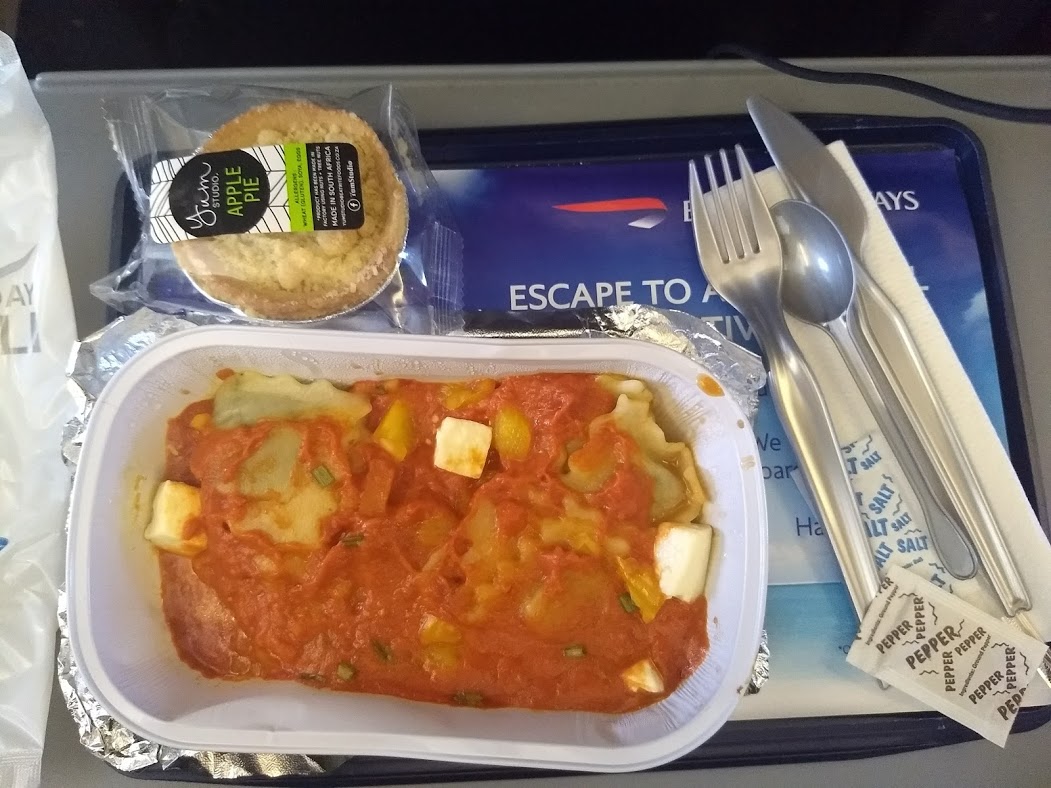
The aircraft was an older 737-800, originally delivered in 2002. It’s very much due for both a deep cleaning (there was set-in grime) and a cabin refresh; European BA cabins look a lot nicer but they also have been refitted with newer slimline seats while this aircraft has not been. The flight was almost completely full and only two hours long but the flight attendants still managed to get out a beverage service, a hot lunch, and a second beverage service.

airline meal picture

Spinach ravioli with feta, with apple pie accompaniment

One really annoying thing about flying to or within South Africa is the electronics rules. Held over from the early 2000s, airlines are absolutely zealous about allowing no use of portable electronics at all for completely unreasonable lengths of time. I was using my tablet and listening to headphones, and the flight attendant came by, scolded me, and made me turn everything off the moment we started descending. It’d be great to see South African aviation authorities retire these outdated and antiquated rules like most of the rest of the world has done.

Bottom line

While I don’t think it’s worth paying extra to fly British Airways in South Africa, I wouldn’t hesitate to fly them again. They got me to my destination safely, on time, with my bags, and I wasn’t hungry when I landed. And I got miles in my preferred frequent flier program (Alaska Airlines Mileage Plan)

Points I redeemed

The trip would have cost $78.39 in cash, but I redeemed 5,226 Chase Ultimate Rewards points. Yes, I realize that this was only 1.5 cents per point in value. However, this was far better value than the 7,500 Avios (plus $42 in taxes and fuel surcharges) the flight would otherwise have cost. In addition to this, I will receive 500 Alaska Airlines Mileage Plan miles for the flight (it’d only qualify for 125 Avios or American Airlines points because of the fare class I bought, but Alaska has a 500 mile minimum credit per flight). Although I might theoretically get some better value by preserving optionality for a future flight, this is a flight I wanted to take right now, it’s cash I didn’t want to spend right now, and it was available at the real price (not some arbitrarily higher price as is often the case) on the Chase portal. So to me, this was a no-brainer.